- Exercises
- Back and core
- Open book stretch
Open book stretch
The open book is a side-lying stretch where you open your top arm across your body like the cover of a book, turning your chest toward the ceiling. It helps your upper back turn more easily and gently stretches your chest.
Also called Side-lying open book, Thoracic open book.
- WorksBack and core
- You needMat
- LevelBeginner
- TryA sample amount: 2 sets of 6 slow reps on each side, pausing for a breath in the open position.
Movement reviewed by a licensed physiotherapist.
How to do it
Lie on your side on a mat with your head on a pillow, and your hips and knees bent to about right angles, stacked on top of each other. Reach both arms straight out in front of you, palms together.
- Keeping your knees together, slowly lift your top arm up and over, turning your chest toward the ceiling.
- Follow your hand with your eyes and open as far as is comfortable.
- Pause, then bring the arm back over to meet the other hand.
What you should feel
You should feel your upper back turning, with a gentle stretch across the front of your chest and shoulder. Let your neck follow the movement, and keep your shoulders soft.
Muscles worked
- Chest (pectoralis major)
- Front of your shoulder (anterior deltoid)
Watch out for
- Keep your knees stacked on the mat so the turn comes from your upper back.
- Don't force the arm toward the floor.
- Use a pillow thick enough to keep your head level with your spine.
Breathe out as you open and breathe in as you return.
When to stop. Stop if you feel sharp pain, or tingling or pain spreading into your arm.
Good for
- If you spend a lot of the day hunched over a screen
- Before golf, tennis or other sports where you twist
- As a gentle floor move to start the day
- When your upper back feels stuck
Easier and harder versions
Routines with this move
10 min routine
10-minute morning mobility routine8 min routine
Neck and shoulder exercises for desk workersQuestions
What does the open book stretch do?
It turns your upper back, the part of your spine between your shoulder blades, and stretches the front of your chest and shoulder. Keeping your knees stacked makes sure the turn comes from your upper back and not your lower back.
Does my hand need to touch the floor behind me?
No. Open only as far as is comfortable; for many people the hand stays well off the floor. The range often grows a little as you repeat it.
Open book vs thread the needle: which should I do?
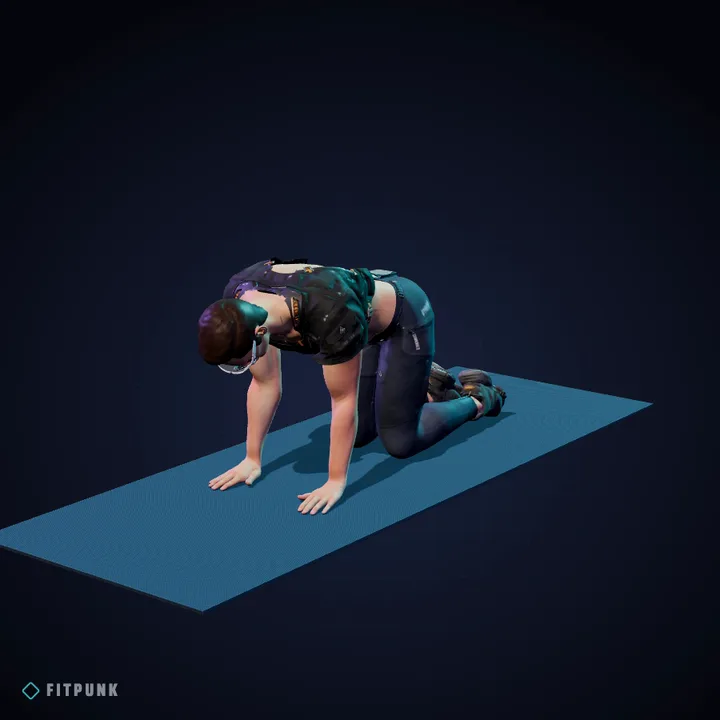
Both turn your upper back. The open book is fully supported by the floor, so it's the easier place to start; thread the needle is done on your hands and knees and adds a stretch at the back of your shoulder.
Sources
Do it in Fitpunk.
Your coach puts moves like this into short sessions at home, and every session you finish earns points that light up a city. Fitpunk is coming soon to iPhone.
Join the waitlist